
Radon Levels in Michigan: Quick Overview
- There is no completely safe radon level. Radon is a radioactive gas, and exposure can increase the risk of lung cancer.
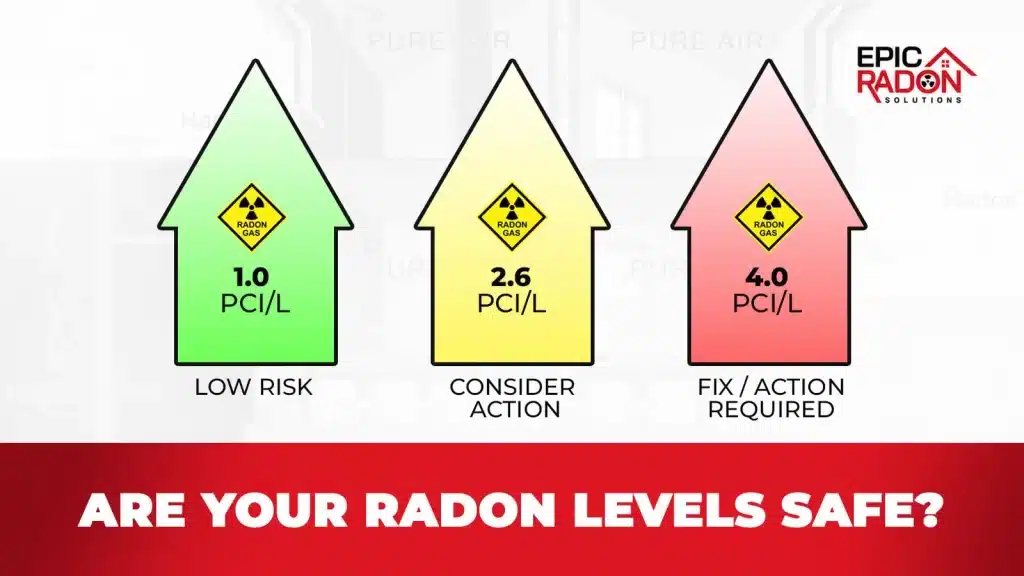
- 4.0 pCi/L is the EPA and Michigan action level. At or above 4.0 pCi/L, homeowners should take steps to reduce radon. Levels between 2.0 and 4.0 pCi/L are below the action level but may still warrant consideration of radon reduction.
- Michigan has a significant radon problem. Michigan EGLE estimates that about 25% of Michigan homes have elevated radon levels above 4.0 pCi/L, with elevated levels found in all 83 Michigan counties. Testing is the only way to know your home’s actual radon level.
If you have recently tested your home, you might be asking: what radon level is truly safe in Michigan? Radon gas concentration is measured in picocuries per liter (pCi/L). Understanding your test results is essential to determining whether you need follow-up testing or active radon mitigation.
First, it is important to understand that there is no completely risk-free level of radon exposure. However, the U.S. Environmental Protection Agency (EPA) and the state of Michigan set the official action threshold at 4.0 pCi/L or higher.
Crucially, 4.0 pCi/L is a practical action level, not a health safety guarantee. Radon risks exist even below this benchmark.
Data from the Michigan Department of Environment, Great Lakes, and Energy (EGLE) indicates that roughly 25% of homes across Michigan have elevated radon levels exceeding 4.0 pCi/L.
In early 2026, EGLE re-confirmed that approximately one in four Michigan residences project above the EPA threshold, with elevated concentrations documented in all 83 counties.
Radon forms naturally from the decay of uranium in soil and rock. The invisible, odorless, and tasteless gas enters structures through foundation cracks, sump pumps, and construction joints. Because it lacks physical warning signs, professional or home testing is the only way to detect its presence.
Understanding Radon Levels: A Quick Reference Guide
Scientific research confirms that radon health risks scale continuously—meaning there is no arbitrary number where exposure suddenly becomes completely benign. Because radon is radioactive, long-term exposure at lower concentrations still contributes incrementally to lung cancer risk.
Use these general ranges to evaluate your test results:
- Below 2.0 pCi/L: Relatively low. While minimal risk remains, standard maintenance involves routine retesting every few years.
- 2.0 to 3.9 pCi/L: Below the immediate action threshold, but still elevated. Consider preventive reduction strategies and consult a certified radon specialist.
- 4.0 pCi/L or higher: Reaches the EPA action threshold. Active radon mitigation is strongly recommended.
- 10.0 pCi/L or higher: Substantially elevated. Requires urgent professional evaluation and installation of a mitigation system.
Appropriate next steps also depend on whether your measurements stem from short-term screening tests or long-term monitoring.
What Does pCi/L Mean?
pCi/L stands for picocuries per liter—the standard unit measuring radiation decay per liter of indoor air.
Higher pCi/L values reflect greater radiological exposure. Indoor concentrations fluctuate constantly due to changing weather patterns, barometric pressure, soil moisture, heating/cooling dynamics, and home ventilation.
Because short-term factors can cause temporary spikes or dips, a single short-term screening test might not fully capture your home’s true annual average.
The EPA Radon Action Level Explained
The official EPA action level is 4.0 pCi/L.
At or above 4.0 pCi/L, the EPA explicitly advises installing a radon reduction system to protect long-term health.
However, the agency also encourages homeowners to consider mitigation when levels fall between 2.0 and 4.0 pCi/L. Lowering indoor radon below 4.0 pCi/L yields meaningful health protections.
Think of 4.0 pCi/L as a maximum acceptable boundary for intervention, rather than a line separating safe air from unsafe air.
Is 4.0 pCi/L a Safe Radon Level?
No. A reading of 4.0 pCi/L is not considered completely safe.
Rather, it represents the threshold where public health authorities determined mitigation becomes practical and highly cost-effective.
Because radon is a leading cause of lung cancer among non-smokers, overall risk rises in direct proportion to concentration and duration of exposure.
Where feasible, the overarching goal should be reducing indoor radon to the lowest achievable level.
Breaking Down Test Result Ranges
Below 2.0 pCi/L
Results below 2.0 pCi/L represent minimal indoor accumulation.
Assuming the test followed proper protocol, immediate mitigation is typically unnecessary. Still, low measurements do not equal zero risk.
Because environmental conditions and building foundations shift over time, retesting every 2 to 5 years remains a smart practice.
2.0 to 3.9 pCi/L
While technically beneath the official 4.0 pCi/L boundary, readings in this bracket warrant attention.
The EPA suggests evaluating reduction options in this range, particularly for households with higher health sensitivities or long indoor occupancy times.
Consider conducting a follow-up long-term test or consulting a licensed contractor to explore simple reduction measures.
4.0 pCi/L or Higher
Readings at or exceeding 4.0 pCi/L demand concrete action to lower indoor levels.
If this result came from an initial short-term screening kit, confirm it with a secondary test—or proceed directly to professional consultation if initial numbers are significantly high.
A certified radon contractor can assess your building physics and design an effective active soil depressurization system.
10.0 pCi/L or Higher
A measurement of 10.0 pCi/L or higher represents severe radon accumulation.
Homeowners in this tier should address the situation promptly. Contact a certified mitigation professional without unnecessary delay to schedule system installation.
Note that while 10.0 pCi/L reflects a heightened urgency, 4.0 pCi/L remains the baseline EPA benchmark for mitigation.
Why Lower Radon Levels Still Matter
A prevalent belief is that any measurement under 4.0 pCi/L is automatically harmless.
However, medical research demonstrates that low-level radioactive exposure carries cumulative effects over decades.
Lowering indoor concentrations—even when starting from a baseline like 3.0 pCi/L—directly lowers cumulative health exposure for everyone in the home.
In short: treat 4.0 pCi/L as a line for mandatory intervention, not a threshold of absolute safety.
Why Radon Testing Is Critical in Michigan
Geological conditions across Michigan make radon a widespread issue, though levels vary wildly from neighborhood to neighborhood.
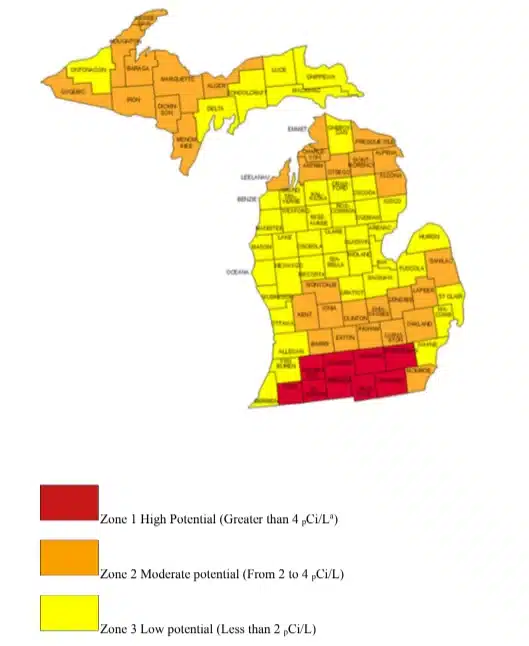
The EPA designates Michigan as a Zone 1 state, signifying high predicted potential for elevated indoor radon levels statewide.
However, regional maps cannot predict individual home risks. Two adjacent houses can register drastically different readings depending on soil makeup, foundation permeability, HVAC draw, and structural sealing.
Because radon is completely invisible and odorless, testing remains the sole method to evaluate your living environment accurately.
Recommended Next Steps for Michigan Homeowners
Your action plan depends on your recorded test numbers:
- Below 2.0 pCi/L: Document your results and plan for standard periodic retesting.
- 2.0 to 3.9 pCi/L: Consider follow-up testing or practical ways to reduce radon accumulation.
- 4.0 to 9.9 pCi/L: Take active steps toward mitigation and verify with follow-up testing.
- 10.0 pCi/L or higher: Contact a certified radon mitigation professional immediately.
When in doubt, reaching out to a certified professional ensures you receive personalized guidance based on your home’s layout.
Short-Term vs. Long-Term Radon Testing
Selecting the right testing duration is critical for reliable data:
Short-term tests (2 to 90 days): Provide a rapid snapshot, ideal for initial screening or urgent real estate transactions.
Long-term tests (90 days to 1 year): Account for seasonal shifts and offer the most precise picture of your true year-round average.
Following standardized testing protocols ensures your decisions are backed by dependable measurements.
How Often Should You Retest for Radon in Michigan?
A single low test result does not guarantee low radon levels indefinitely.
Soil settling, seasonal changes, foundation shifts, and structural updates can open new pathways for radon gas entry.
The EPA recommends retesting every two years, as well as immediately following major renovations, basement finishing, or HVAC upgrades.
If you have never tested your living space, ordering a test kit is an easy and vital first step.
Why Radon Levels Fluctuate
Indoor radon levels are dynamic and shift across seasons or weather events.
Primary drivers of radon concentration changes include:
- Seasonal weather and barometric fluctuations
- Differences between indoor and outdoor air pressure
- Soil moisture and frost levels
- Foundation condition and settling cracks
- Overall ventilation rates and window usage
- Heating and cooling stack effects
- Remodeling or building structural modifications
These variables underline why periodic testing is necessary to maintain accurate long-term oversight.
What Is an Acceptable Radon Level in Michigan?
To reiterate: there is no zero-risk radon level.
Both the EPA and Michigan EGLE use 4.0 pCi/L as the action threshold where mitigation becomes standard recommendation.
For readings between 2.0 and 4.0 pCi/L, exploring mitigation or preventive steps is still encouraged to minimize cumulative exposure.
Ultimately, the objective is not just staying barely below a regulatory threshold—it is reducing indoor radon exposure as low as reasonably achievable.
Frequently Asked Questions About Michigan Radon Levels
Is 2.0 pCi/L a safe radon level?
A reading of 2.0 pCi/L is relatively low, but it is not considered completely risk-free. Lowering radon exposure can further reduce potential health risks.
Is 3.0 pCi/L a safe radon level?
A reading of 3.0 pCi/L is below the EPA’s 4.0 pCi/L action level, but it does not mean there is zero risk. The EPA recommends considering ways to reduce radon when levels are between 2.0 and 4.0 pCi/L.
Should I be concerned about a 4.0 pCi/L reading?
Yes. A reading of 4.0 pCi/L meets the EPA action level. Homeowners should take steps to reduce radon and can consult a qualified radon professional about appropriate mitigation options.
Is 5.0 pCi/L dangerous?
A reading of 5.0 pCi/L is above the EPA action level of 4.0 pCi/L. Homeowners should take action to reduce radon exposure and consider professional guidance on the appropriate mitigation approach.
What steps should I take for a 10.0 pCi/L result?
A 10.0 pCi/L result is substantially elevated. Arrange for professional evaluation and take steps to reduce the radon level. Depending on the testing method and circumstances, follow-up testing may also be appropriate.
Is Michigan considered a high-radon state?
Yes. Michigan is classified by the EPA as a Zone 1 state, indicating a high predicted potential for elevated indoor radon. However, radon levels can vary from home to home, so testing your own property is important.
Does a low initial test mean my home stays safe permanently?
No. Radon levels can change over time because of weather, ventilation, soil conditions, renovations, and changes to the building. Periodic retesting can help you monitor your home’s radon level.
Key Takeaways
What radon level is considered safe in Michigan?
There is no completely safe radon concentration. However, 4.0 pCi/L serves as the official action threshold established by both the EPA and Michigan state guidelines.
Levels between 2.0 and 3.9 pCi/L warrant consideration for reduction, while results of 4.0 pCi/L or higher require active mitigation.
For every Michigan homeowner, the path forward is clear: test your living spaces, analyze your pCi/L readings accurately, and mitigate elevated radon promptly.