
Direct answer:
What Is the Best Radon Mitigation System?
The best radon mitigation system depends on your home’s foundation type, current radon levels, and construction design. For most homes with basements or concrete slabs, active sub-slab depressurization is the most commonly recommended solution. Homes with crawl spaces often require submembrane depressurization, while homes with existing drain tile systems may benefit from drain tile suction systems.
A certified radon professional can evaluate your home and recommend the most effective system for your specific situation.
Introduction
Finding out your home has elevated radon levels can create an important question:
“What is the best radon mitigation system for my home?”
The answer depends on several factors, including:
- Your foundation type
- Your home’s layout
- Current radon concentration
- Soil conditions
- Existing drainage systems
- Installation requirements
A system that works well for a basement may not be the right choice for a crawl space or slab-on-grade home.
Understanding the different types of radon mitigation systems can help you make an informed decision and choose the right solution for your property.
How Do Radon Mitigation Systems Work?
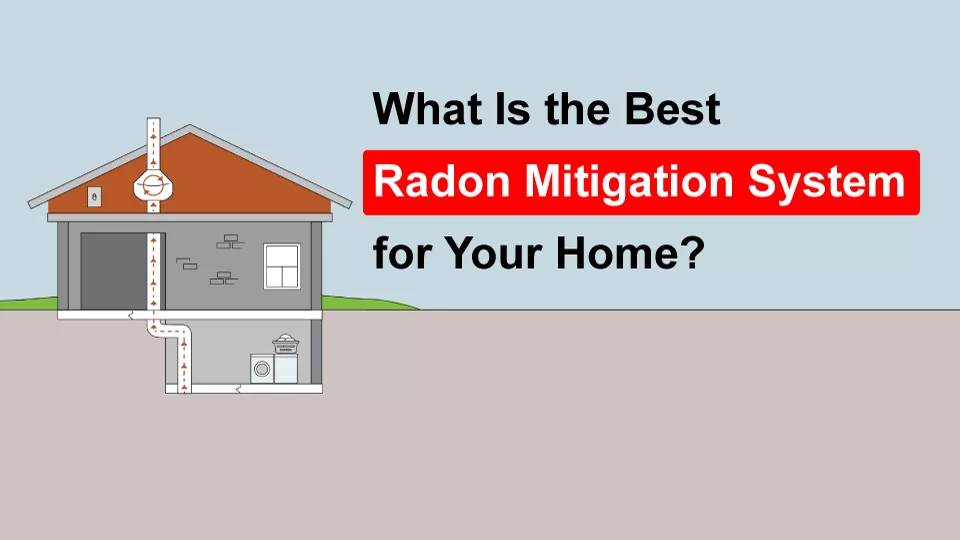
Radon mitigation systems work by reducing the amount of radon entering your living space.
Most systems use:
- A collection point beneath the home
- A PVC ventilation pipe
- A specialized radon fan
- Safe exhaust outside the building
The system creates negative pressure beneath the foundation, pulling radon gas away before it enters your home.
What Is the Most Common Radon Mitigation System?
The most common system is:
Active Sub-Slab Depressurization (SSD)
This method is widely used for homes with:
- Basements
- Concrete slabs
- Slab-on-grade foundations
How It Works
A small opening is created through the concrete slab.
A pipe is inserted into the soil beneath the foundation.
A radon fan creates suction and moves radon gas through the pipe system.
The gas is safely exhausted outdoors.
System #1: Sub-Slab Depressurization
Best For:
✓ Homes with basements
✓ Concrete slab foundations
✓ Slab-on-grade construction
Advantages:
- One of the most effective radon reduction methods
- Works continuously
- Requires minimal homeowner involvement
- Can be customized based on home design
Considerations:
- Requires fan operation
- Exterior piping may be visible
- Fan replacement may eventually be needed
Recommended When:
Your home has a basement or concrete foundation with elevated radon levels.
System #2: Drain Tile Depressurization
Best For:
Homes with existing perimeter drain tile systems.
Drain tiles are designed to move water away from foundations. Because these systems already create pathways beneath the home, they can sometimes be used to collect and exhaust radon.
Advantages:
- Uses existing drainage pathways
- Can reduce radon effectively
- May require fewer suction points
Considerations:
- Not every home has drain tile
- Requires professional evaluation
Recommended When:
Your home has an existing drain tile system suitable for radon collection.
System #3: Crawl Space Radon Mitigation
Best For:
Homes with crawl spaces.
Crawl spaces often have exposed soil, making them common areas for radon entry.
The preferred solution is usually:
Submembrane Depressurization
Installation Process:
- A durable vapor barrier is installed over exposed soil.
- The membrane is sealed around walls and supports.
- A suction pipe is installed beneath the membrane.
- A fan pulls radon from beneath the barrier.
- The gas is vented safely outside.
Benefits:
- Reduces radon entry
- Helps control crawl space moisture
- Improves overall indoor air quality
System #4: Passive Radon Mitigation Systems
Best For:
- New construction
- Homes designed with radon-resistant features
Passive systems use natural airflow instead of a fan.
They typically include:
- A vent pipe beneath the foundation
- A route through the home
- Exhaust above the roofline
Advantages:
- Lower operating cost
- No fan electricity use
Limitations:
- May not reduce high radon levels enough
- May require conversion to an active system
Radon Mitigation System Comparison Chart
| System | Best For | Effectiveness | Maintenance |
|---|---|---|---|
| Sub-Slab Depressurization | Basements & slabs | High | Low |
| Drain Tile Depressurization | Homes with drain tile | High | Low |
| Crawl Space System | Crawl spaces | High | Moderate |
| Passive System | New construction | Variable | Very Low |
How Do You Choose the Right Radon System?
1. Consider Your Foundation Type
Your foundation is the biggest factor.
| Foundation Type | Common Solution |
|---|---|
| Basement | Sub-slab depressurization |
| Crawl space | Submembrane depressurization |
| Slab foundation | Sub-slab system |
| Mixed foundation | Combination approach |
2. Consider Your Radon Level
Higher radon levels may require:
- Additional suction points
- Larger fans
- Customized system design
A professional evaluation helps determine the correct approach.
3. Consider System Appearance
Many homeowners worry about visible pipes.
Professional installers can often route piping through:
- Garages
- Utility rooms
- Closets
- Less visible exterior locations
4. Consider Long-Term Reliability
A quality system should include:
- Proper fan sizing
- Durable materials
- Warning devices
- Post-installation testing
How Much Does a Radon Mitigation System Cost?
Cost depends on:
- Foundation type
- Home size
- System complexity
- Number of suction points
- Installation requirements
Typical factors include:
| Factor | Impact |
|---|---|
| Basement | Standard installation |
| Crawl space | More complex installation |
| Multiple foundations | Higher complexity |
| Difficult pipe routing | Additional labor |
A professional estimate provides the most accurate pricing.
Common Mistakes Homeowners Make When Choosing a System
| Mistake | Why It Causes Problems |
|---|---|
| Choosing the cheapest option | May not address the actual radon source |
| Installing without testing | System may be incorrectly designed |
| Using sealing only | Usually not enough for elevated radon |
| Ignoring foundation type | Wrong system may underperform |
If you live in Michigan or Indiana and need a certified radon professional:
Epic Radon Solutions
✔ NRPP-certified • Family-owned • 15+ years experience
Proudly serving Detroit, Grand Rapids, Ann Arbor, Lansing, Fort Wayne, South Bend — and communities across all of Michigan & Indiana