
What is Radon?
Radon is one of the most misunderstood risks in your home.
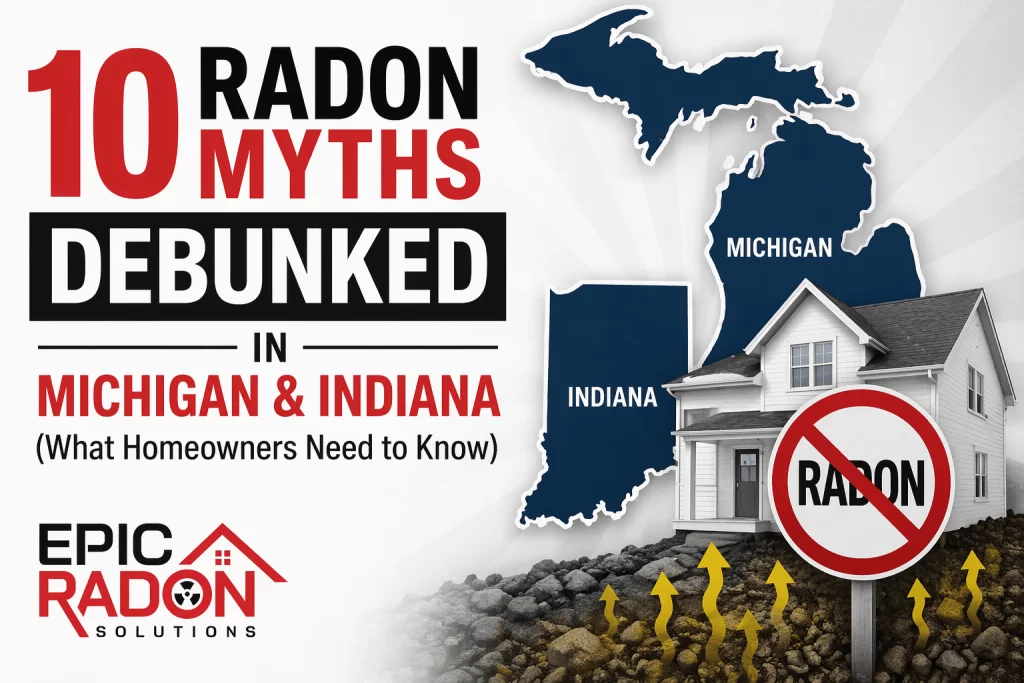
Because it’s invisible and odorless, many homeowners rely on assumptions instead of facts. In regions like Michigan and Indiana—where elevated radon levels are common—these misconceptions can lead to serious health risks.
This guide breaks down the most common radon myths and explains the facts you actually need to protect your home.
Are Radon Myths Dangerous?
Yes, radon myths can be dangerous.
They create a false sense of safety and delay testing or mitigation. The only way to know your risk is to test your home.
Myth #1: Radon Is Not a Serious Health Risk
Fact: Radon is a proven carcinogen and the second leading cause of lung cancer in the United States.
Myth #2: Only Old Homes Have Radon
Fact: New homes can have equal or even higher radon levels due to airtight construction that traps gas indoors.
Myth #3: My Neighbor Tested Low, So I’m Safe
Fact: Radon levels vary from house to house—even next door. Testing results cannot be shared or assumed.
Myth #4: No Basement Means No Risk
Fact: Radon enters through any foundation type, including slabs and crawl spaces.
Myth #5: You Can Detect Radon Without Testing
Fact: Radon is colorless, odorless, and tasteless. Testing is the only way to detect it.
Myth #6: Sealing Cracks Solves the Problem
Fact: Sealing helps, but it does not eliminate radon. Most homes require an active mitigation system for effective reduction.
Myth #7: Short-Term Tests Are Not Reliable
Fact: Short-term tests are effective for identifying a problem, while long-term tests provide a more accurate yearly average.
Myth #8: Mitigation Systems Are Expensive and Noisy
Fact: Most systems are affordable and operate quietly, similar to common household appliances.
Myth #9: It’s Too Late to Test
Fact: Reducing radon levels at any time lowers future lung cancer risk.
Myth #10: You Don’t Need to Test After Mitigation
Fact: Regular testing is still necessary. Systems must be verified to ensure they continue working effectively.
What These Myths Mean for Homeowners
These myths all lead to one problem: delayed action.
Radon exposure happens over time. The longer it goes untested or untreated, the higher the risk.
In regions like Michigan and Indiana, where elevated levels are common, testing should be considered a standard part of home safety.
Frequently Asked Questions
Yes. Many homes in these regions have elevated radon levels.
Every 2 years, or after major renovations.
4.0 pCi/L or higher requires action.
It significantly reduces levels, often by up to 99 percent.
Professional testing provides more accurate and reliable results.
Conclusion
Radon myths are common—but they are also risky.
Every assumption that delays testing increases potential exposure. The facts are simple: radon is dangerous, common, and only detectable through testing.
The safest approach is not to guess.
Get a Professional Radon Assessment
Radon exposure builds over time. Waiting only increases the risk.
Epic Radon provides fast testing and engineered mitigation systems designed to reduce radon levels quickly and effectively. Their approach focuses on accurate diagnostics and proven solutions tailored to your home.
Take action now and get a clear answer before exposure continues.